
Are MYGA rates higher
than CD rates in 2026?
Written by Stina Antonopoulos
Founder of Roots & Wealth | Retirement Income Planning | Author of What If? (Coming August 2026)
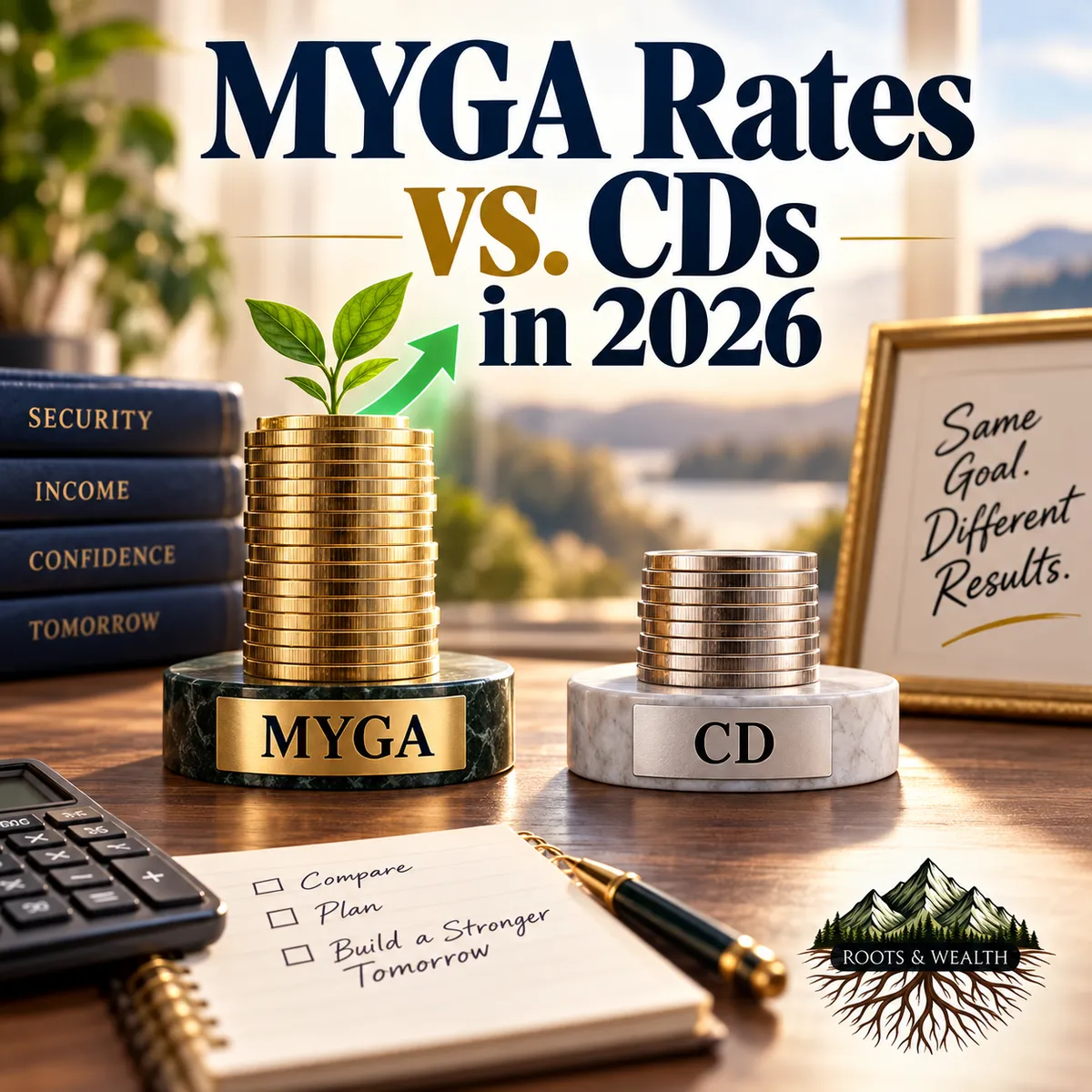
Yes, on some comparable terms. As of early September 2026, top 5-year MYGAs were around 6.30%, while leading nationally available 5-year CDs were roughly 4.40%–4.45%. That is a difference of approximately 1.85 percentage points, although rates, carrier strength, deposit requirements and contract terms vary.
That difference deserves attention.
But I would not stop at the rate.
A MYGA and a CD can both be used for money you want protected from direct stock-market volatility, but they are not the same product.
Understanding the differences is more important than simply choosing whichever number is higher.
What is a MYGA?
MYGA stands for Multi-Year Guaranteed Annuity.
It is a type of fixed annuity issued by an insurance company.
You place money into the contract for a specified term, often three, five, seven or ten years, and the insurer guarantees a stated interest rate according to the contract.
Think of it like a fixed-rate strategy with a time commitment.
That is similar in concept to a CD.
But there are important differences.
What is a CD?
A certificate of deposit is a bank or credit-union deposit account.
You agree to leave money deposited for a specified term in exchange for a stated interest rate.
Bank CDs at FDIC-member banks are generally insured within applicable FDIC limits; credit-union CDs may receive NCUA coverage.
That government-backed deposit insurance is a major distinction from annuities.
MYGAs are not FDIC insured.
Their contractual guarantees depend on the financial strength and claims-paying ability of the issuing insurance company.
How large is the current rate difference?
As of September 7, 2026:
A leading 5-year MYGA was approximately 6.30%
Leading 5-year CDs were approximately 4.40%–4.45%
That creates a gap of approximately 1.85 percentage points, or 185 basis points.
That does not mean every MYGA beats every CD.
For example, leading 3-year CDs are currently around 4.50%, while top 3-year MYGAs are around 6.00%–6.10%, producing a somewhat smaller gap.
So the comparison needs to be made term against term.
What does 185 basis points actually mean?
“Basis points” makes the difference sound more complicated than it is.
One hundred basis points equals one percentage point.
So a 185-basis-point difference means:
1.85 percentage points.
If one product guarantees 6.30% and another offers 4.45%, the difference is 1.85%.
On larger balances, that can become meaningful.
For $100,000, ignoring tax differences, compounding differences and contract specifics, that is roughly $1,850 more interest during the first year.
On $300,000, the simple first-year difference is approximately $5,550.
That is why rate shopping matters.
But there is another difference that can be just as important.
MYGA interest is generally tax-deferred
Interest earned inside a nonqualified annuity generally grows tax-deferred until money is withdrawn.
With a traditional taxable CD, interest is generally reportable as taxable income as it is credited, even if you leave the interest in the CD.
That does not automatically make the MYGA better.
Taxes are generally deferred, not erased.
When taxable earnings eventually come out of a nonqualified annuity, they are generally taxed as ordinary income.
But tax deferral may be useful for someone who does not need the interest today and wants the money to continue accumulating.
Why are MYGA rates sometimes higher?
Banks and insurance companies operate differently.
A bank may price CDs based on its need for deposits, competition and the interest-rate environment.
Insurance companies invest heavily in bonds and other long-term assets and price annuity guarantees based partly on the yields available in those portfolios.
That can create periods when insurers are willing to offer substantially higher guaranteed rates.
It is also why MYGA rates can move independently from CD rates.
Does the higher MYGA rate automatically make it better?
No.
This is where I think consumers need to slow down.
A higher number does not eliminate the trade-offs.
A CD may be better when:
FDIC or NCUA deposit insurance is important to you
You want a shorter commitment
You may need the money sooner
You prefer a bank product
The rate difference is small
A MYGA may be worth considering when:
The money is intended for longer-term safe growth
You do not need full liquidity during the surrender period
The guaranteed rate is materially higher
Tax deferral is valuable to you
The issuing insurer's financial strength meets your standards
The contract provisions fit your needs
Neither answer is universally correct.
What about liquidity?
This may be the most important difference to understand.
Both products may penalize early withdrawals.
A CD usually has an early-withdrawal penalty.
A MYGA may have:
Surrender charges
Limits on penalty-free withdrawals
A market value adjustment
Specific provisions for death, nursing-home confinement or other circumstances
These vary dramatically by contract.
So if this is money you may need next year, the highest five-year MYGA rate may be irrelevant.
The purpose of the money comes before the rate.
That principle fits the way I prefer to explain these products: people should understand what they are getting and what they are giving up rather than being sold on a headline number.
What about carrier ratings?
This is another place where simply advertising “the highest MYGA rate” can be misleading.
The current 6.30% 5-year MYGA high includes insurers with different financial-strength ratings.
For example, current market data shows top rates varying based on insurer rating, with some A- or better carriers offering slightly lower rates than the absolute market high.
That is a trade-off worth understanding.
Would you take 6.30% from one carrier?
Or would you prefer 6.00%–6.15% from an insurer with a different financial-strength rating?
There is not one answer.
But you should know the difference before signing the contract.
A MYGA is not a replacement for emergency savings
This is important.
Money needed for emergencies should generally remain accessible.
A MYGA is a long-term insurance contract.
I would not put the household emergency fund into a five-year annuity simply because the rate looks attractive.
Your cash reserve has one job.
Your longer-term protected money may have another.
Different money can do different things.
FAQ: MYGA vs. CD
Are MYGAs safer than CDs?
They have different protections. CDs issued by FDIC-insured banks are covered within applicable federal insurance limits. MYGAs are insurance contracts and are not FDIC insured; guarantees depend on the issuing insurer's claims-paying ability.
Are MYGA rates guaranteed?
The credited rate on a traditional MYGA is guaranteed according to the terms of the contract for the specified guarantee period. Rates available to new purchasers can change before the contract is issued.
Are MYGA rates higher than CDs right now?
For some terms, yes. In early September 2026, leading 5-year MYGA rates were around 6.30%, compared with roughly 4.40%–4.45% for leading 5-year CDs.
Is MYGA interest taxable every year?
For a nonqualified MYGA, growth generally accumulates tax-deferred until withdrawal. Different tax rules apply to qualified retirement money, so individual tax advice should come from a tax professional.
Should I move my CD into a MYGA?
Not simply because the rate is higher.
First compare:
Rate
Term
Liquidity
Early-withdrawal provisions
Tax treatment
Insurer financial strength
Deposit insurance
Your expected need for the money
Then decide which product better matches the purpose of those dollars.
The Bottom Line
The current MYGA/CD rate gap is significant enough that I think anyone renewing a large CD should at least know the alternative exists.
For comparable five-year terms, the difference is currently around 185 basis points at the top end of the market.
But this should not become:
“MYGAs pay more, so everyone should buy one.”
That is not good planning.
The better question is:
What do I need this money to do?
If you need liquidity and federal deposit insurance, a CD may be exactly right.
If the money is designed for longer-term protected growth and you can accept the contractual restrictions, a MYGA may offer a materially higher guaranteed rate plus tax deferral.
Know the rate.
Know the guarantees.
Know the liquidity.
And then make the decision.
This material is for general educational purposes and is not individualized tax, investment or legal advice. Annuities are long-term insurance contracts and may contain surrender charges, withdrawal limitations and market value adjustments. Guarantees are backed by the financial strength and claims-paying ability of the issuing insurer. Annuities are not FDIC insured. Consult an appropriate tax professional regarding your individual tax situation.
This Is Why I'm finishing up My Next Book
My upcoming book, Create a Pension: Get A GLIP, is being written for this generation.
Not to tell retirees what product to buy.
Not to convince everyone to use the same strategy.
And certainly not to suggest there's one perfect retirement answer.
The intention is much more important:
I want to put retirees back in the driver's seat.
For decades, many people were told what to do with retirement money.
Save more.
Invest more.
Hope the market cooperates.
Then retirement arrives and suddenly they're expected to make some of the biggest financial decisions of their lives—often without ever having been taught how retirement income actually works.
I want to change that.
The purpose of the book is to help readers understand the choices in front of them, understand the trade-offs, ask better questions, and ultimately feel capable of making informed decisions about their own money.
Because knowledge shifts power back to the retiree.
You Don't Need One Perfect Product
You need a plan.
Maybe Social Security covers most of your essential expenses.
Maybe it doesn't.
Maybe part of your savings needs to create lifetime income.
Maybe you value liquidity more.
Maybe leaving money to your children matters enormously.
Maybe it doesn't matter at all—you worked for this money and want to maximize the retirement it provides.
Those are personal decisions.
And that's exactly why retirement planning should begin with you, not with a product.
Ready to Take the Next Step?
Retirement isn't just about numbers. It's about the life you've worked so hard to build.
Whether your dream is traveling more, spending time with your grandchildren, supporting the causes you care about, or simply enjoying the peace of knowing your bills are covered, your financial decisions today can shape the future you envision.
I believe every family deserves honest guidance, thoughtful education, and a retirement strategy built around their unique goals—not a one-size-fits-all recommendation.
Throughout my career, I've had the privilege of helping individuals and families navigate important financial decisions involving retirement income, life insurance, annuities, mortgages, and real estate. One thing I've learned is that every family's story is different, and every retirement plan should be too.
Before we ever talk about products or strategies, I want to understand you.
What does financial freedom mean to you? What are your biggest concerns? What kind of legacy do you hope to leave? Those conversations are the foundation of every recommendation I make because the best plans begin with listening.
My role isn't to tell you what to do. My role is to educate you, simplify complex financial decisions, and help you feel confident in the choices you make for yourself and your family.
Whether you're just beginning to plan for retirement or looking for a second opinion on your current strategy, I'd be honored to be a resource for you.
Why "Roots & Wealth"?
When I chose the name Roots & Wealth, it wasn't just because it sounded good. It reflects what I believe financial planning should be.
Just like a strong tree, lasting financial security begins with strong roots.
Those roots are built through education, thoughtful planning, meaningful conversations, and decisions that align with your values. Wealth isn't only about the size of your portfolio—it's about having choices, creating stability, protecting the people you love, and living with confidence.
Life will bring changing seasons. Markets will rise and fall. Tax laws will change. Unexpected challenges will happen. But when your financial foundation is built on strong roots, you're in a better position to weather those changes and continue growing.
That's the philosophy behind everything I do.
My goal is to help you build a retirement strategy that's deeply rooted in what matters most to you, so you can enjoy today while creating a lasting legacy for tomorrow.
If you're ready to build a retirement strategy with confidence and clarity, I'd love the opportunity to meet you. Schedule your complimentary Retirement Strategy Consultation and let's start growing your Roots & Wealth together.
Educational Disclosure
This article is for educational purposes only and is not financial, tax, or legal advice. Annuity products are insurance contracts. Guarantees are backed by the claims-paying ability of the issuing insurance company. Product availability, rates, surrender schedules, withdrawal provisions, riders, caps, participation rates, spreads, and other terms vary by carrier and state. Withdrawals may be subject to surrender charges, taxes, and, if taken before age 59½, potential IRS penalties. Fixed index annuities are not stock market investments and do not directly participate in any stock or equity index. You should review your personal situation with a qualified professional before making a decision.
ROOTS & WEALTH
a subsidiary of SJA Financial Services, LLC
CA Lic. 4374774 | NPN 20996862
Phone: 707-WEALTH7 | 707-932-5847
Email: [email protected]
Address: Saint Augustine FL 32092

* Guarantees are backed by the financial strength and claims-paying ability of the issuing insurance company. Annuities are long-term financial vehicles designed for retirement purposes. These products contain limitations, including withdrawal charges, fees, and a market value adjustment, which may affect contract values.
This information is for educational purposes only and should not be construed as investment, tax, or legal advice. Please consult with your financial professional before making any financial decisions.
Copyright 2026. All Rights Reserved.


